Most office towers put their feet where you expect them: at the corners. Citicorp Center does something more interesting. Look past the sloping roof and down toward the street, and the building becomes a small architectural puzzle. Why are its great supports in the middle of the sides? And how did a church become part of the answer?
Citicorp Center, now 601 Lexington Avenue, is a Midtown East architecture stop rather than an observation-deck attraction. Allow about 20–30 minutes for an exterior look and photographs. Viewing it from the public sidewalk costs nothing; food and commercial services are separate.
By CenterNYC Editorial · Sources checked October 13, 2026 · Read in Hebrew · קראו בעברית
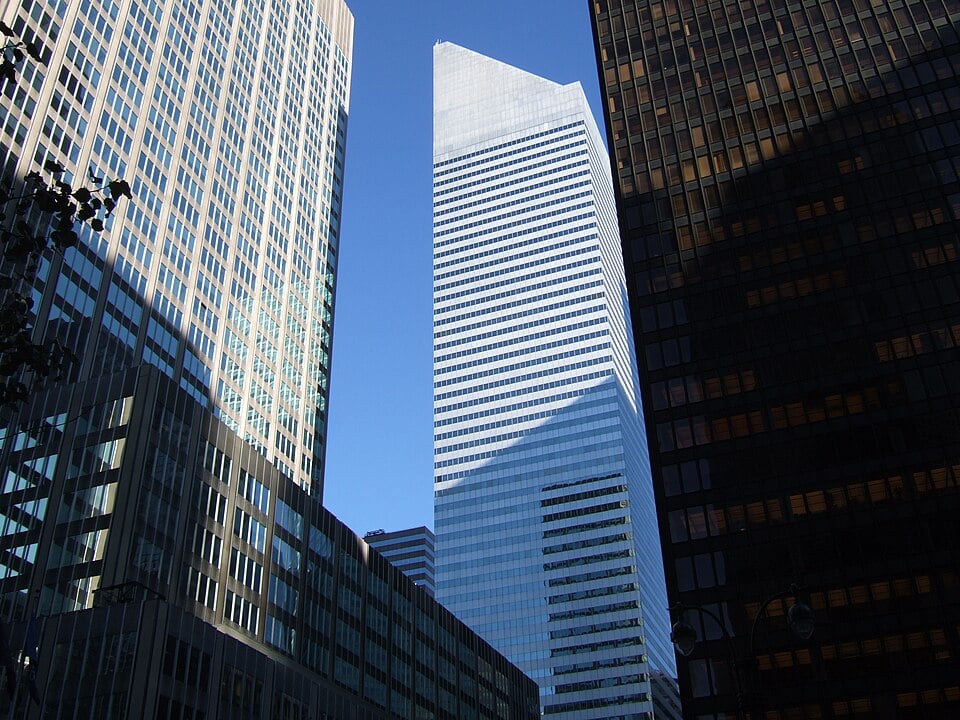

Look at the feet, then the roof
The complex combines a 59-story tower, a lower office-and-retail building and Saint Peter’s Church. Hugh A. Stubbins & Associates worked with Emery Roth & Sons on the design. New York’s Landmarks Preservation Commission designated the complex in 2016, recognizing an unusually memorable piece of late-20th-century architecture.
Its four immense columns rise 127 feet, while the roof ends at a 45-degree angle. The lower church uses granite rather than the tower’s aluminum, giving the two buildings distinctly different characters. Once you notice those contrasts, the site becomes much more than another tall building with a famous name.
The column arrangement helped accommodate the church at a corner of the site. For children, try a simple question before explaining it: if you were building a tower out of blocks, where would you put the legs? The difference between their answer and the building is the beginning of the story.
A famous story with a less familiar second chapter
In 1978, an engineering student’s question prompted the chief engineer to reconsider the tower’s response to winds striking its corners. The decision was made to strengthen structural braces, with work carried out at night while offices remained in use. Joe Morgenstern brought the episode to a wide audience in The New Yorker in 1995.
There is a reason not to end the account with a breathless claim that catastrophe was certain. A 2019 NIST account of later research challenged the familiar explanation of the corner-wind problem. Its analysis used wind-tunnel data from a similarly proportioned building, rather than the original confidential tests. The researchers argued that the rationale for the retrofit needed re-examination.
The compelling part is still there: a question, a second look and a decision to act. You do not need an invented disaster scene to make a skyscraper interesting.
A small stop that fits a real Midtown day
| Detail | What to plan |
|---|---|
| Building | 601 Lexington Avenue, between East 53rd and 54th Streets. Open Google Maps. |
| Time | 20–30 minutes for the exterior; roughly an hour if you add a neighborhood walk. These are editorial planning estimates. |
| Cost | $0 for viewing from public sidewalks. Purchases are extra. |
| Indoor option | The Hugh, 157 East 53rd Street. Its official site lists Monday–Friday, 7 a.m.–9 p.m.; individual restaurant hours differ, with selected businesses open on weekends. |
| Best fit | Architecture, street photography and a short stop between larger plans. |
Begin around Lexington and 53rd Street. Look up for the roof, then bring your attention back to the base. Continue toward 54th Street for a different view of the tower and the lower structures. Choose a comfortable position on the sidewalk and let the commuters get past; you are looking at a working office complex.
The Hugh provides an indoor change of scene when open, and takes its name from architect Hugh Stubbins. Its opening hours apply to that venue, not automatically to every public space in the complex. For kosher dining, choose a separately verified business from our kosher restaurant guides.
The building owner’s page describes direct access to the subway station below. Use current transit directions for your starting point and accessibility needs. A short architecture stop should simplify your day, not send you hunting for an entrance that does not suit your route.
Photographs that explain the building
- Across Lexington Avenue: look for a position that gives the tower some breathing room between its neighbors. The diagonal roof is easier to understand when you include enough sky.
- Near the base: make the supports the subject. A tighter photograph can tell more about the design than trying to squeeze the entire skyline into one frame.
- Along 54th Street: try a composition showing the contrast between the low structures and the tower above. Keep entrances clear and stay out of the roadway.
For this exterior visit, daylight is our preference: it makes the shapes easier to read. Rain changes the experience considerably, even with an indoor stop available nearby. This is not a substitute for a full indoor museum afternoon.
Keep walking, but pick a direction
If you are building a day around architecture, continue south toward Grand Central Terminal for a very different kind of monumental space. If your main booking is MoMA or Top of the Rock, use this as an optional Midtown detour and leave enough time for the walk west.
There is no prize for collecting every building before lunch. Choose one principal visit, then use a stop like this to give the journey between bookings a little character. Our landmarks and history guides offer more places that work at that scale.
Quick answers
Can you visit an observation deck at Citicorp Center?
This guide covers the exterior and public spaces at the base. It does not include access to office floors or a tourist observation deck.
Do you need a ticket?
No ticket is needed to look at the building from public sidewalks. Food and other commercial purchases are separate.
How long should you spend here?
Allow about 20–30 minutes for the exterior and photographs, or around an hour with a surrounding walk.
This researched guide uses the city landmark designation, NIST’s historical analysis, the owner’s property page and The Hugh’s current visitor information. It is not a personal visit report.
Another building with an unexpected story
For a separate Lower Manhattan outing, explore 33 Thomas Street, the windowless telecommunications tower. Its blank stone walls offer a striking contrast to Citicorp Center. Allow a short look from the public sidewalk; it is not an interior tour or observation deck.