New York has a sign that turns the usual family arrangement upside down: the grown-up needs a chaperone. And the chaperone needs to be a child. It is an easy detail to laugh at—until you are looking for a quiet bench and realize you have walked into the wrong part of the park.
The short answer: in an area designated by signs as an exclusive children’s playground, NYC’s rule allows adults only when accompanied by a child under 12. This is not a blanket ban on adults visiting parks. Look at the entrance sign and the boundaries of the particular area.
By Zvi Zidon and the CenterNYC editorial team · Official information checked October 13, 2026.
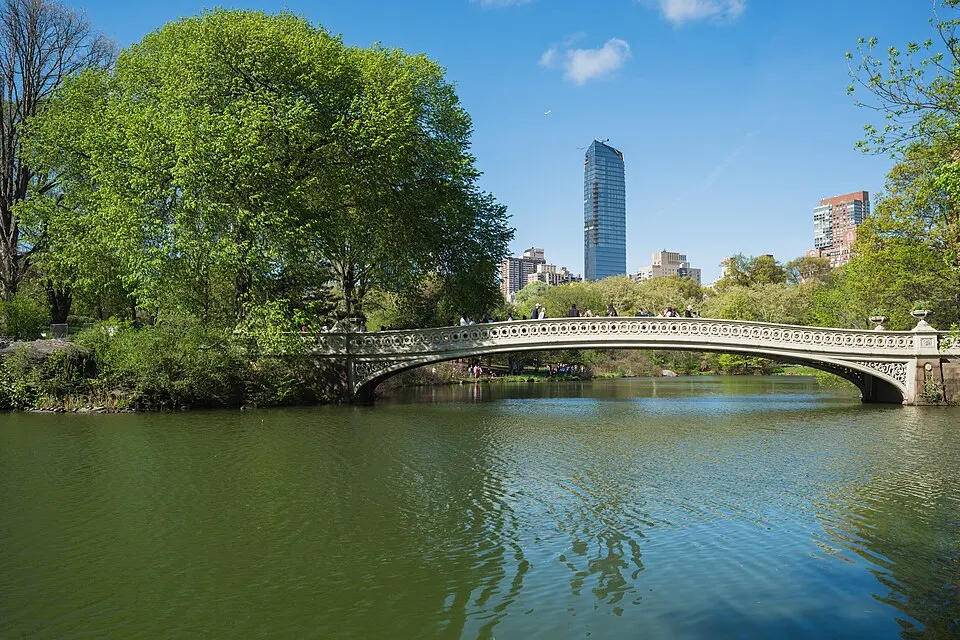

Bow Bridge is part of the wider Central Park landscape, not the playground described below.
A park bench and a playground bench are not always the same thing
The relevant provision is NYC Parks rule 1-05(s)(1). The designation is made through posted signs. A bench inside that designated area does not become an exception simply because you plan to sit rather than use the slide.
| What you find | What it means for your visit |
|---|---|
| A signed exclusive children’s playground | Adults need to be accompanying a child under 12. |
| A large park with several separate areas | Read the signs for the area you are entering, rather than treating the whole park as one facility. |
| A gate with hours posted | Use those hours; playground schedules differ. |
| An unclear boundary | Ask park staff where the designated area ends. |
If you are traveling without children, there is no reason to abandon a park afternoon. Choose public paths and seating areas open to you. Our Central Park guide offers a walk built around the landscape, with no playground needed.
The stop your child may remember better than the observation deck
You booked the museum. You researched the skyline. Your child has spotted a climbing frame and would like to renegotiate the itinerary. This is not necessarily a problem with the trip. Sometimes it is the part that makes the next hour work.
Our planning suggestion is to leave 30–45 minutes for a nearby playground rather than crossing the city for a supposedly perfect one. That is a flexible allowance, not an official visit duration. Put it between activities, keep the next reservation comfortably far away, and give a little warning before it is time to leave.
Choose for the child you have with you: a toddler needs something different from an energetic ten-year-old. Bring water, consider shade and the weather, and make the bathroom stop before the request becomes urgent. Our NYC restroom guide links to the city’s map.
Find the right facilities, not just a green patch on the map
The official NYC Parks playground directory and map lets you compare locations and facilities. Its accessibility information distinguishes accessible entrances or play elements, limited wheelchair access, accessible restrooms and inclusive features. Open the individual listing: a wheelchair-accessible entrance does not tell you whether every piece of equipment suits your child.
Hours vary by playground. The directory also lists restrictions on bicycles, scooters, skates, skateboards and pets; read the posted rules before entering. Service animals have separate rules from pets. If something about access is essential to your day, settle it for the particular location rather than relying on a general park description.
Adventure Playground: a useful Central Park example
Near the park’s West 67th Street entrance, Adventure Playground gives school-age children tunnels, climbing forms and maze-like spaces to explore. Designed by Richard Dattner and opened in 1967, it belongs to a generation of playgrounds built around imaginative movement rather than a row of standard equipment.
The Conservancy lists an accessible surface, water feature and sand table—but no restrooms. That last detail may matter more to your afternoon than a beautiful photograph. A listed water feature also does not promise it will be operating on your visit date.
Use this as a possible break during a west-side park outing, not an extra destination to squeeze between two timed tickets. The official page has photographs and location information, so you can decide whether its layout looks right for your family.
Make room for food, weather and the journey back
A playground break works best when nobody arrives hungry and the adults are not calculating whether they can still make a booking across town. Plan a kosher meal or packed snack separately; a nearby café is not automatically a kosher option. Our kosher restaurant guides identify the places covered by our reporting.
For a sightseeing itinerary, keep these outings to suitable weekdays outside Jewish holidays, leaving Friday afternoon for Shabbat preparations. Rain or uncomfortable cold is a good reason to shorten an outdoor plan. The NYC with kids guide has indoor alternatives and ideas for a less crowded day.
And if the children want another ten minutes, you have a genuine planning decision: the next landmark may still be there tomorrow.
Frequently asked questions
Can adults visit NYC parks without children?
Yes. The restriction discussed here concerns areas signed as exclusive children’s playgrounds. Follow the rules for each part of the park.
How old must the accompanying child be?
The city rule for designated exclusive children’s playgrounds specifies a child under 12.
Do all playgrounds have bathrooms?
No. Look up the particular playground in the NYC Parks directory and check its restroom information and posted hours.
How much time should we leave for a play break?
Our suggested starting allowance is 30–45 minutes near the day’s route. Adjust it to your children, the weather and the next commitment.
Sources are linked beside the relevant information. Pacing and itinerary suggestions are editorial advice. This is a citywide planning guide, not a review of one playground.